Want to know what makes our packages unique?
Our history
Diet plays a very important role in health and general well-being: this is an open secret. For this reason, followers of alternative therapies and gentle medicines like naturopathy are constantly looking for ways to improve their diet.
In this context, superfoods have been increasingly highlighted for several years now. Among them, spirulina stands out, possessing unparalleled nutritional qualities and from which phycocyanin is extracted.
Discover here everything you need to know about spirulina as well as the benefits you can gain from its consumption!
Contrary to popular belief that considers it a microalga, spirulina is actually a food based on cyanobacteria. These are photosynthetic organisms more commonly referred to as blue-green algae.
The name spirulina is directly linked to the fact that spirulina naturally develops by forming characteristic spirals. With its presence on Earth dating back billions of years, spirulina is consumed in various forms.
In countries such as Mexico, Chad, and India, spirulina is consumed by people who recognize its nutritional potential. The success this microorganism has experienced as a nutritional support in recent years has notably driven its intensive cultivation worldwide.
Thus, China, the United States, and France have established themselves as the largest producers of spirulina globally. Depending on the cultivation region and the methods used, more than 36 different species of edible spirulina can be produced.
Even before its detailed nutrient composition was widely revealed in the 20th century, spirulina was already used to enrich several meals.
Spirulina contains a large amount of chlorophyll and phycocyanin, which are the plant pigments responsible for its distinctive color. From a nutritional perspective, spirulina is a complete food, as it notably contains:
This composition is therefore very rich: spirulina is one of the foods that contains the most nutrients essential for a balanced diet. The World Health Organization (WHO) also considers it the most nutritious food for humanity in the 21st century.
Due to its rich content of active compounds and nutrients, spirulina offers numerous benefits. This cyanobacterium is primarily acclaimed worldwide for the virtues it provides for health and well-being. These virtues concern various organs, for which a spirulina regimen is sometimes recommended.
Spirulina is composed of nearly 70% of its mass in protein. Unlike most animal-based proteins, spirulina contains very little fat. This allows athletes who incorporate it into their diet to build muscle more easily.
This cyanobacterium primarily supports the muscle recovery phase, which is crucial for sustainable muscle building. By facilitating this process, spirulina optimizes athletic performance and the endurance of the athlete who consumes it.
It also promotes muscle definition when consumed in the right proportions. Due to its entirely natural origin, spirulina is an essential food for building muscle while maintaining a vegan diet.
The proteins contained in spirulina include the essential amino acids necessary for muscle regeneration. The size of the molecules that make up spirulina's structure makes it a food rapidly assimilated by the body.
Athletes who consume it therefore receive nutrient intake almost instantaneously. Spirulina can be used to enrich meals before sports sessions.
The many vitamins it contains are a source of energy that can then be expended during athletic exertion. This is notably the case for vitamins B1, B2, and B3, which are known to play a very important role in the body's energy synthesis.
The balance of various nutrients in the body is easily disrupted when the diet is not rich enough or the environment is not healthy enough. In the current era, where foods are increasingly processed before reaching our plates, the toxic loads they contain are significant.
This imbalance manifests through various negative impacts on general well-being and the health of skin or hair. To restore balance, it is sometimes necessary to resort to detox regimens to eliminate accumulated toxins and prevent more serious ailments.
As the human body's purification plant, the liver should be the primary target for toxin elimination regimens. The amino acids contained in spirulina are a great help in this regard, as they enable the liver to eliminate accumulated harmful substances.
Iron, selenium, and superoxide dismutase (SOD), which are among the enzymes present in spirulina, have protective properties against oxidation. In this way, the effect of toxins is gradually reduced, and cells are protected from damage.
The antioxidant functions of the cyanobacterium also provide support for the body's various purifying functions.
To maintain vitality, strengthening your natural defenses is essential. While your natural defenses primarily depend on lifestyle and genetics, it is entirely possible to boost them with an appropriate diet and food supplements.
In this regard, spirulina can be beneficial due to its stimulating action that supports natural defenses. By consuming spirulina as part of a healthy and balanced diet, you help build an additional barrier against external aggressions.
Furthermore, spirulina is valuable for addressing various trace element deficiencies and nutrient shortages. Iron deficiency, which is very common, especially among women, can be alleviated by including spirulina in one's diet.
Indeed, it contains enough iron to easily meet daily iron requirements and provide other nutrients. Vegetarians and vegans will therefore find it a suitable solution for substituting certain nutrients typically found in animal-derived foods.
While spirulina is beneficial for the body, it also offers virtues related to the field of beauty. It is therefore no longer uncommon to serendipitously find spirulina-based cosmetic products in supermarkets and specialized stores.
The cocktail of minerals and vitamins present in the cyanobacterium can be beneficial for caring for the skin, nails, and of course, hair. Whether you have oily or dry skin, spirulina-based treatments can help you achieve a brighter complexion and healthier skin.
It can also be used to develop anti-wrinkle treatments, as vitamins A and E are widely used to prevent the appearance of skin aging signs. Spirulina's restorative properties could help eliminate imperfections or scars for smoother skin.
Spirulina's high amino acid content promotes the production of keratin, which ensures hair growth. Thus, a spirulina hair mask could promote hair growth.
B-group vitamins, which are partly found in spirulina, contribute to strengthening hair fibers by sheathing them.
Consuming spirulina can therefore be beneficial for your general well-being. How can you consume it?
Spirulina comes in various forms, but the most common are capsules and tablets. Easy to transport and swallow, this form helps avoid the unappreciated taste of spirulina in the mouth. In this form, spirulina dosage becomes much simpler.
However, it sometimes contains additives that degrade the quality of the product. To avoid this, make sure to check that the capsules offered to you are dried at low temperatures and then compressed without excipients.
The ingredient list should also be checked to ensure that products like talc or silica are not present.
Spirulina flakes are indeed the least processed form of the cyanobacterium. While sourced from traditional producers, this form of spirulina does not, however, match the properties of Fresh Spirulina, which alone preserves the integrity of the food in its original state. The nutritional quality of spirulina flakes remains valid if drying is carried out at low temperatures between 40° and 45°C. Depending on the production method and the quality of the culture medium, the taste can vary and be more or less pronounced. Flakes can be sparingly incorporated into cooking in salads or beverages.
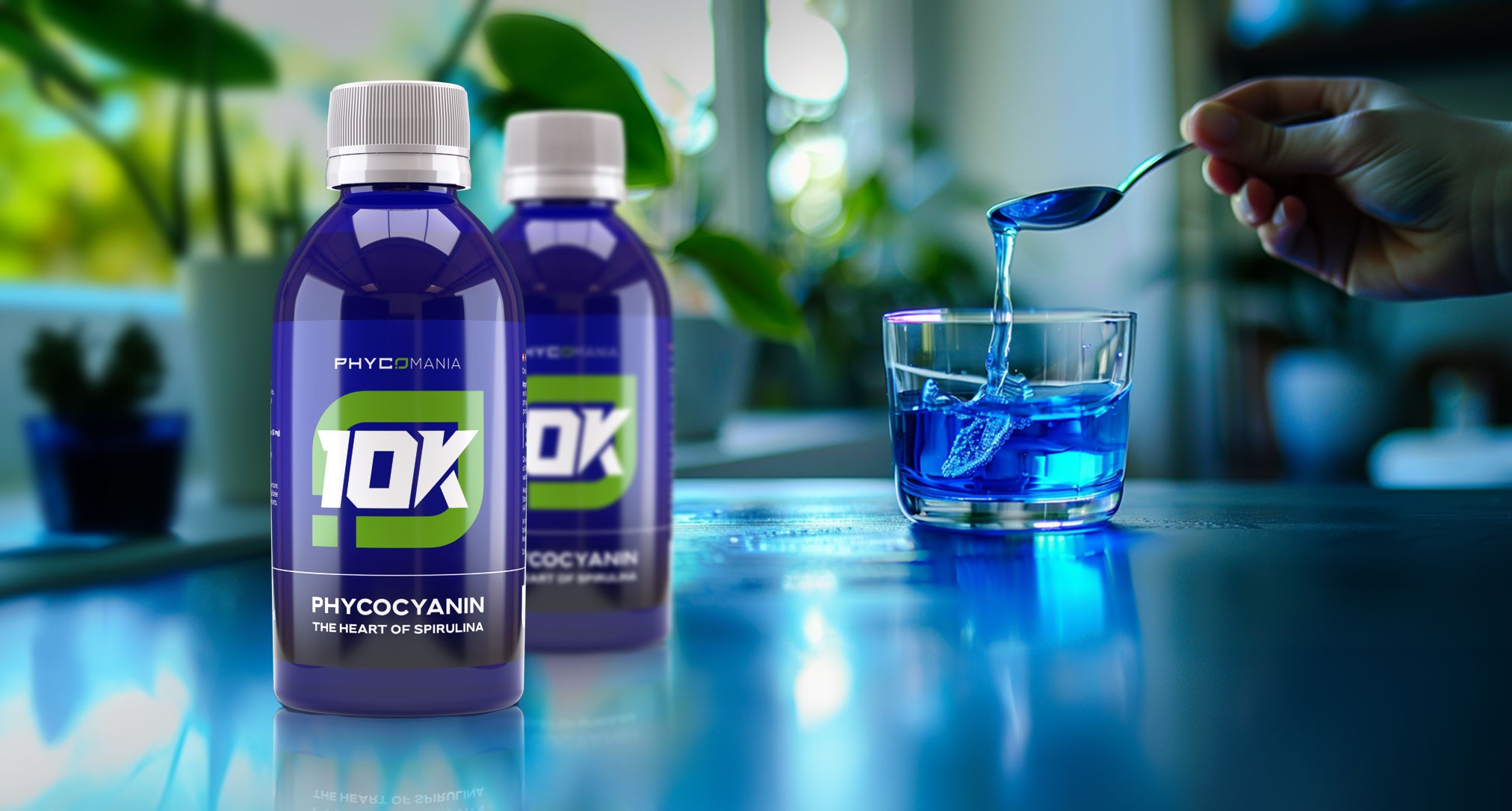
In liquid form, as syrup or in breakable ampoules, we are generally referring to Phycocyanin, a cyan blue pigment composed of 3 liquid proteins bound to water.
Phycocyanin, in light of the research it generates, is considered one of the most powerful energy catalysts in the world, from a nutritional standpoint.
Dehydrated phycocyanins on the market are no longer bound to water and lose their native health potential; only the pigment remains.
To benefit from phycocyanin's advantages, one must choose phycocyanin in its native liquid form, purely extracted and stabilized from quality fresh Spirulina, with a sufficient phycocyanin content. This is the type of phycocyanin that Phycomania offers.